Here are three little functions that allow for brunching logical pipes as defined in magrittr package. It is against Hadley’s idea, as pipes are in principle linear, and in general I agree, but sometimes it would be comfy to ramify pipes away. It overcomes native magrittr %T>% by allowing more than one step after cutting the pipe. Imagine you need to create a list with means, correlations, and regression results. And you like to do it in one single pipe. In general, it is not possible, and you’ll have to start a second pipe, probably doing some redundant computations. Here is an example that allows it:
data.frame(a=1:5, b=1/(1+exp(6:10)) ) %>%
  ramify(1) %>%
    branch(1) %>% colMeans %>%
    branch(2) %>% lm(a ~ b, .) %>% broom::tidy(.) %>%
    branch(3) %>% cor %>%
      ramify(2) %>%
        branch(1) %>% round(2) %>%
        branch(2) %>% psych::fisherz(.) %>%
      harvest(2) %>%
  harvest
ramify()- Saves current result into temporary object.bufand identifies a point in the pipe where branching will happen. Argument is an id of ramification.branch()- Starts a new brunch from theramifypoint. (brunch(1) can be omitted, as ramify creates the first brunch. Second argument is a family of branches, or parent branch. By default it uses the last parent branch created by last usedramify.harvest()- Returns contents of all the brunches as a list and clears the buffer.
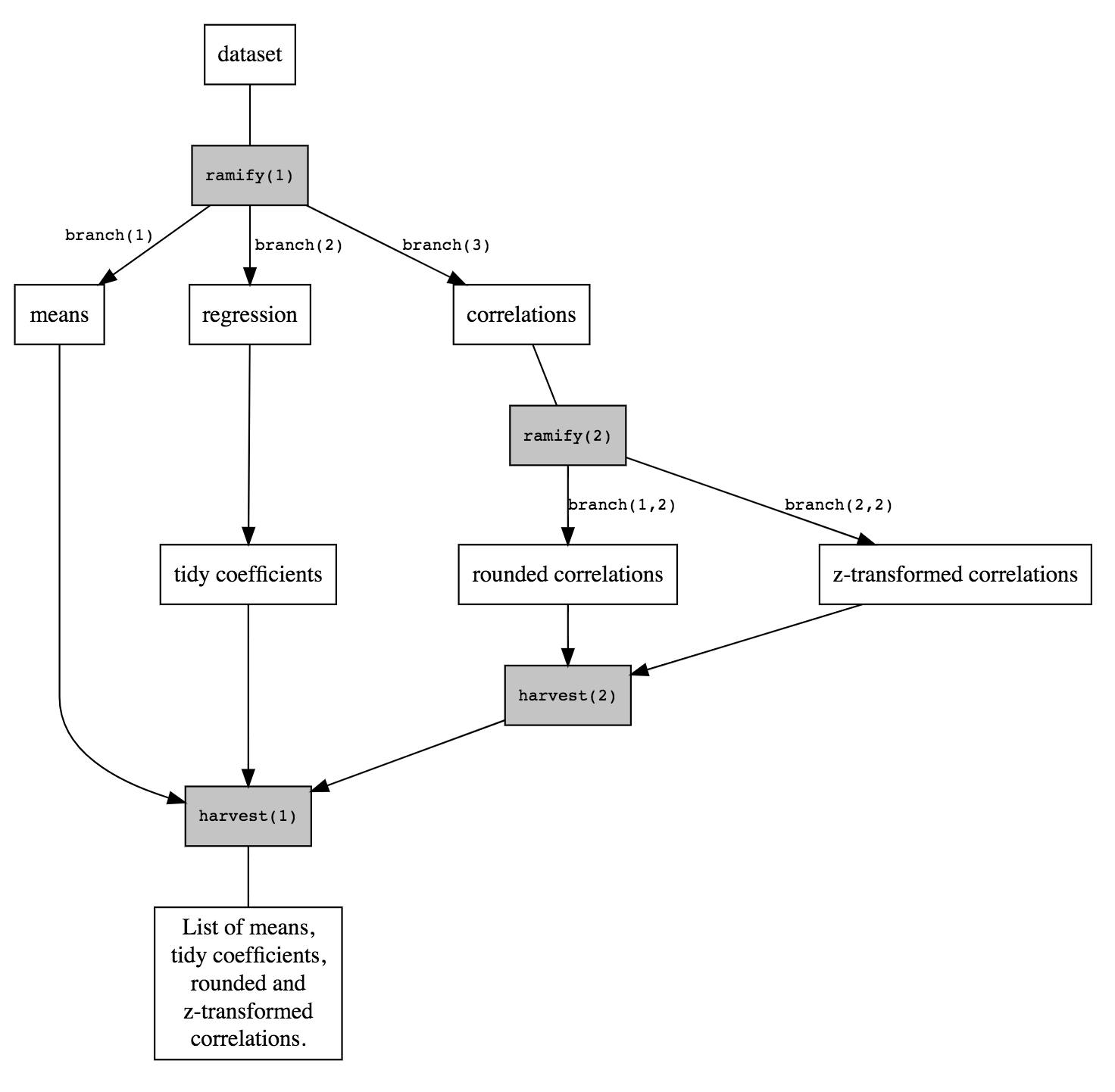
See proof of concept https://gist.github.com/MaksimRudnev/bf81eab9f39bd830f9f167c669444472
“Pipes are fundamentally linear and expressing complex relationships with them will typically yield confusing code.” http://r4ds.had.co.nz/pipes.html#when-not-to-use-the-pipe